
Labour law framework on the topic of ‘workation’ - Part 1
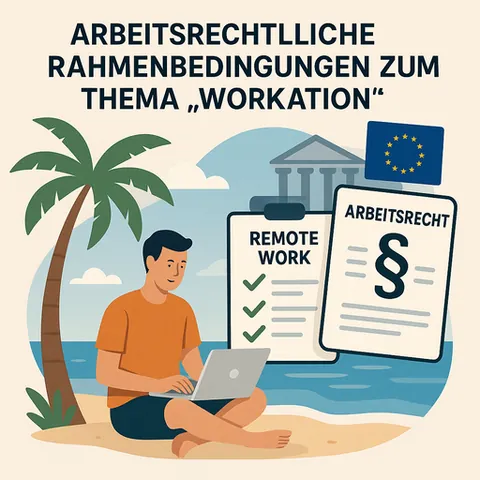
Summer is just around the corner and many employees want to work from a different place in the world. In an increasingly digital and flexible working world, the concept of workation - a combination of work and holiday - is becoming more and more important. This gives employees the opportunity to carry out their professional activities from abroad while enjoying the benefits of a holiday environment. How companies can realise this is explained in the current blog series on the topic of ‘Workation’.
This edition focuses on the topics of company agreements, health and safety and working time:
Despite the obvious benefits, however, workation raises several legal issues. Employers and employees must ensure that legal requirements are adhered to avoid legal risks.
Good to know: There are currently no legal regulations regarding the flexibilization of the place of work. In order to offer flexible working models, it is advisable to include these in employment contracts or works agreements.
What components should a works agreement have in this regard?
- Which employees can work mobile / use a workstation - which cannot?
- Agreements regarding working hours and availability (it is essential to take into account different time zones)
- Liability issues in the event of accidents and illness
- Limiting the duration and frequency of use of mobile working / workation
- Cancellation options
Occupational health and safety and mobile working - potential hazards of mobile working
Possible hazards and restrictions:
- Impairment due to unfavourable ergonomic working conditions (suitable office chair, lighting)
- Suitable conditions for VDU work (screen quality and size)
- Exposure to disturbing external influences (noise, air quality, temperature)
- Stress due to lack of communicative exchange with team members
- Lack of social connection to company events
- Mental stress due to time pressure, availability and insufficient recovery time
But how can the health and safety of employees be guaranteed and based on which legal standards?
- Provision of safe work equipment in accordance with Section 618 BGB
- Instruction of employees in accordance with § 12 ArbSchG
- Carrying out a risk assessment in accordance with 5 ArbSchG
Potential challenges:
Possibility of influencing work circumstances?
Possibility of enforcing instructions?
Working hours
A well-thought-out concept is required for compliance with working time regulations that takes into account the essential framework conditions. This could include working in different time zones. But how can this be mapped?
- Implementation by means of technical and organisational measures (adjustment of meeting times)
- Agreement on a written instruction
Good to know: The Working Hours Act applies exclusively in the Federal Republic of Germany.
Basic regulations:
Maximum working hours:
8 hours per working day
10 hours a day
Rest breaks:
30 minutes after 6 hours
45 minutes after 9 hours
Rest periods:
11 hours between shifts and working days
Good to know: Ban on working on Sundays and public holidays - with exceptions for specific areas
The other legal aspects of ‘workation’ will be explained in the next issue of the blog.